
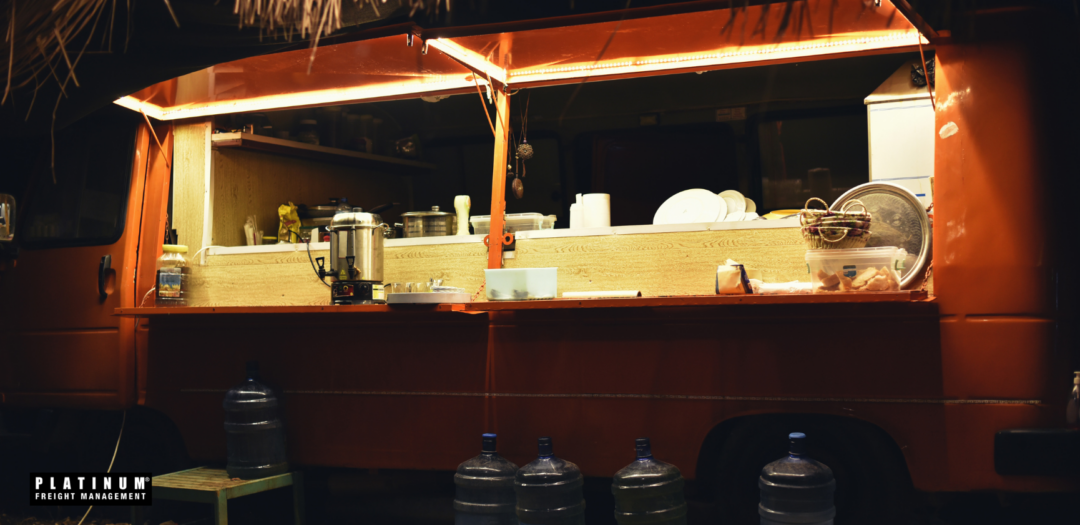
The dream is easy to picture. A custom-built food trailer, manufactured in China to your exact specifications, loaded into a container, shipped to Australia, and delivered to your port ready for business. Compared to sourcing locally, the numbers look compelling. The design options look even better.
The reality of what arrives in that container, and what stands between delivery and the first day of trading, is a different story.
Peter McRae at Platinum® Freight Management has guided food trailer importers through this process more times than he can count. He has also watched importers who did not seek advice early enough open a container and discover that the vehicle they planned to drive onto a market ground that weekend is sitting in the shipping container without wheels or axles and no mechanic booked.
“You open the container and the wheels are horizontal instead of vertical. Well, obviously you are not going to be able to drive this out.”
— Peter McRae | Licensed Customs Broker, Platinum® Freight Management
This is not an edge case. It is what happens in the majority of food trailer imports from China when the importer has not been properly prepared for what they are receiving. And it is entirely avoidable.
The Assumption
What Every Food Trailer Importer Assumes, and Why It Is Wrong
The assumption is consistent across almost every food trailer import Peter has seen. The importer expects to open the container doors, pull the trailer out, and either drive it away or have it towed directly to their first event or trading location.
There are several reasons this does not happen. Understanding each of them before the container leaves China is the difference between a smooth import and a costly, stressful delay.
“Everyone assumes. And when you assume, you are going to have problems.”
— Peter McRae | Licensed Customs Broker, Platinum® Freight Management
A food trailer loaded into a shipping container for international transport is packed to survive a sea voyage, not to be driven from a wharf. The weight distribution required for safe sea freight, the securing requirements for a container load, and the space constraints of fitting a large trailer inside a standard container all mean that the vehicle arrives in a configuration that is nothing like what the importer imagines.
What Actually Arrives
What Is Inside the Container: The Full Picture
A typical food trailer imported from China includes several components that are either disassembled for transport, require compliance checks before use, or need professional attention before the trailer can legally operate on Australian roads.
Peter breaks down what his team looks for on every food trailer import:
Before It Leaves China
The Infrastructure Department Approval: What It Covers and What It Does Not
Importing a road vehicle into Australia, including a food trailer, requires an import approval from the Department of Infrastructure, Transport, Regional Development, Communications and the Arts. This approval must be obtained before the goods depart from overseas, and it is the importer’s responsibility to hold it.
Most food trailer importers know this approval is required and take steps to obtain it. It will take at least 30 business days — or 42 calendar days — to receive the import approval, so this needs to be factored into your timeline before placing a deposit.
The ozone-depleting gas question is managed separately by the Department of Climate Change, Energy, the Environment and Water. An Infrastructure Department approval does not certify the refrigerant gas used in an appliance. That is a separate compliance requirement, confirmed against separate documentation. An importer who has their approval in hand and assumes all compliance boxes are ticked is working with an incomplete picture.
What Platinum® Does Differently
Packing Photos, Mechanic Delivery, and Why Both Matter
Platinum® Freight Management’s approach to food trailer imports starts well before the shipping container is sealed in China. Peter’s team requests photographs of the trailer as it is being loaded into the container. This single step resolves most of the delivery surprises before the shipment leaves from the overseas port.
“We request photos of the food trailer getting packed into the full container. Then we can say to the importer: see the way that they have packed this container, this is exactly how you are going to receive it. Take our advice and let us deliver this full container to your mechanic.”
— Peter McRae | Licensed Customs Broker, Platinum® Freight Management
The packing photos serve several purposes. They show the importer exactly what the container contains and how each component is positioned. They confirm whether wheels and axles are packaged separately or attached. They provide a reference point if anything is damaged in transit. And they allow Peter’s team to identify potential compliance issues in the packed configuration before the container enters Australian waters.
The delivery recommendation is equally important. Rather than having the container delivered to the importer’s home address or trading location, Platinum® recommends that the food trailer is delivered to a qualified mechanic who possesses the equipment to properly assemble the trailer and certify the mechanical work.
Once the wheels are fitted, the axles are secured, and the mechanical work is signed off, the importer can apply to their state motor registry for a temporary permit to tow the food trailer on public roads. Only then is the vehicle ready to trade.
The Supplier Problem
Why “We Ship to Australia All the Time” Does Not Protect You
Food trailer suppliers in China are generally not unfamiliar with the Australian market. Many have shipped dozens of units to Australian buyers. Some have legitimate experience navigating the documentation and compliance requirements.
But the phrase that Peter hears most often from importers who have run into problems is the same one that comes up in prefabricated home imports, vehicle imports, and complex commercial shipments of every kind.
“They use the famous proverb: we ship to Australia all the time. That phrase is used to make people feel safe and secure. But it does not mean that they have the correct paperwork for your specific trailer. And it does not mean everything will be fine.”
— Peter McRae | Licensed Customs Broker, Platinum® Freight Management
A supplier who ships to Australia frequently knows how to pack a container and book a freight forwarder. That experience does not translate into knowledge of Australian ozone-depleting substance regulations, the specific documentation requirements of the Department of Infrastructure, or what a customs broker needs to see before lodging an import clearance declaration.
The importer carries the compliance risk. The supplier carries none of it. Understanding that division of responsibility before placing an order is what separates a smooth import from an expensive lesson.
What to Do Before You Order
The Food Trailer Import Checklist
Peter’s advice is consistent: engage a licensed customs broker before paying a deposit, not after your container has departed. Here is what that preparation should include:
Speak with Platinum® Freight Management
Peter McRae’s team has guided food trailer imports from China through every stage of the compliance and clearance process. If you are planning to import a food trailer and want to understand exactly what is involved before you place your order, call Platinum® Freight Management first.
Call 1300 882 877Every shipment has a number. Every person has a name. Platinum® knows the difference.
Platinum® Freight Management is a licensed customs brokerage operating Australia-wide since 2000. Peter McRae holds a Master of International Customs Law and a Master of International Revenue Administration (University of Canberra) and has been a licensed customs broker since 1998. Member: IFCBAA and Freight & Trade Alliance. ABN 58 095 228 934. This article is general in nature. Requirements may vary depending on the specific vehicle configuration and applicable regulations at the time of import. Speak with a licensed customs broker for advice specific to your situation.